

Rampal Latour combines ancestral savoir-faire and industrial innovation: two patents filed at the end of 2019 reduce the manufacturing process's water consumption by 4 times and energy consumption by 7 times.

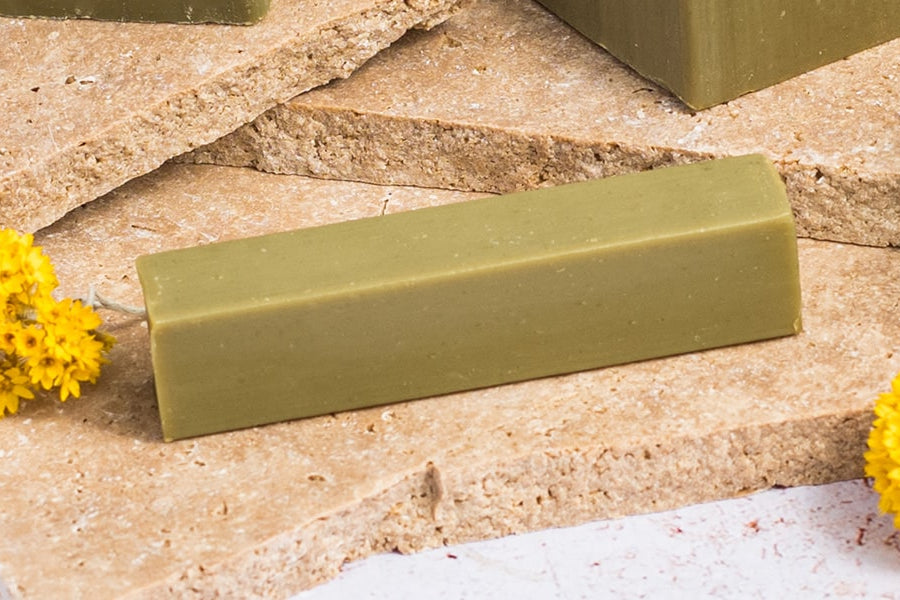
Innovation at Rampal Latour can only be understood in light of the tradition it extends. Marseille soap is made using a precise and demanding cauldron process, the main steps of which have not fundamentally changed for centuries: first, saponification, where exclusively vegetable oils (olive, palm, copra) are heated and then transformed into a thick mass by the addition of soda; then comes salting out, followed by cooking, which completes this chemical transformation. Washing with salt-laden water removes excess soda, impurities, and unsaponified fatty acids: the soap then becomes Extra Pure. Liquefaction gives it its final texture, a smooth paste ready for air drying, which is still carried out today on old wooden racks, using methods inherited from the 1960s. Finally, molding is performed using traditional machines: artisans push each block of paste towards a brass mold that stamps it on six sides, a visual guarantee of authenticity. For certain limited editions, the soap factory goes even further, by reusing a historical collection of boxwood stamps dating from the 19th century. A final quality control, performed by hand, precedes packaging.

By meticulously observing this centuries-old process using modern analysis methods, the Rampal Latour teams uncovered an untapped potential for improvement that had remained untouched for 150 years: the possibility of preserving the glycerin naturally produced during saponification, while ensuring the traditional washing of the soap paste. This glycerin, known for its moisturizing and protective properties, is thus naturally preserved in the finished soap, an unprecedented benefit for the skin. Filed at the end of 2019, the two patents protecting this process also make it possible to reduce water consumption by 4 and energy consumption by 7, with no discharge into the city's wastewater, and without ever abandoning artisanal cauldron manufacturing.

This ability to innovate without betraying tradition has earned Rampal Latour the French State's "Entreprise du Patrimoine Vivant" (EPV) label, awarded by the Ministry of Economy and Finance for the excellence of its savoir-faire, its rare economic heritage, and the cultural influence of its activity. The soap factory received this recognition thanks to its Savon de Marseille, made using the "Marseillais" process, whose criteria were established as early as 1688 by Colbert's edict. As such, Rampal Latour joins a national network of excellent companies, united by common values: adaptability, responsiveness, innovation, and passion for the craft.
This dynamic of innovation did not start in 2019: the first bar soap (1935), the first three-in-one liquid shampoo (1951), the first organic certified range (2008), the first Ecocert certified Extra Pur Marseille soap (2014), each generation of the Rampal family, then Jean-Louis Plot's team, has advanced the trade without ever abandoning the cauldron. In short: innovation at Rampal Latour does not oppose tradition; it extends it, process after process, for nearly a century, until it receives official recognition from the French State.