
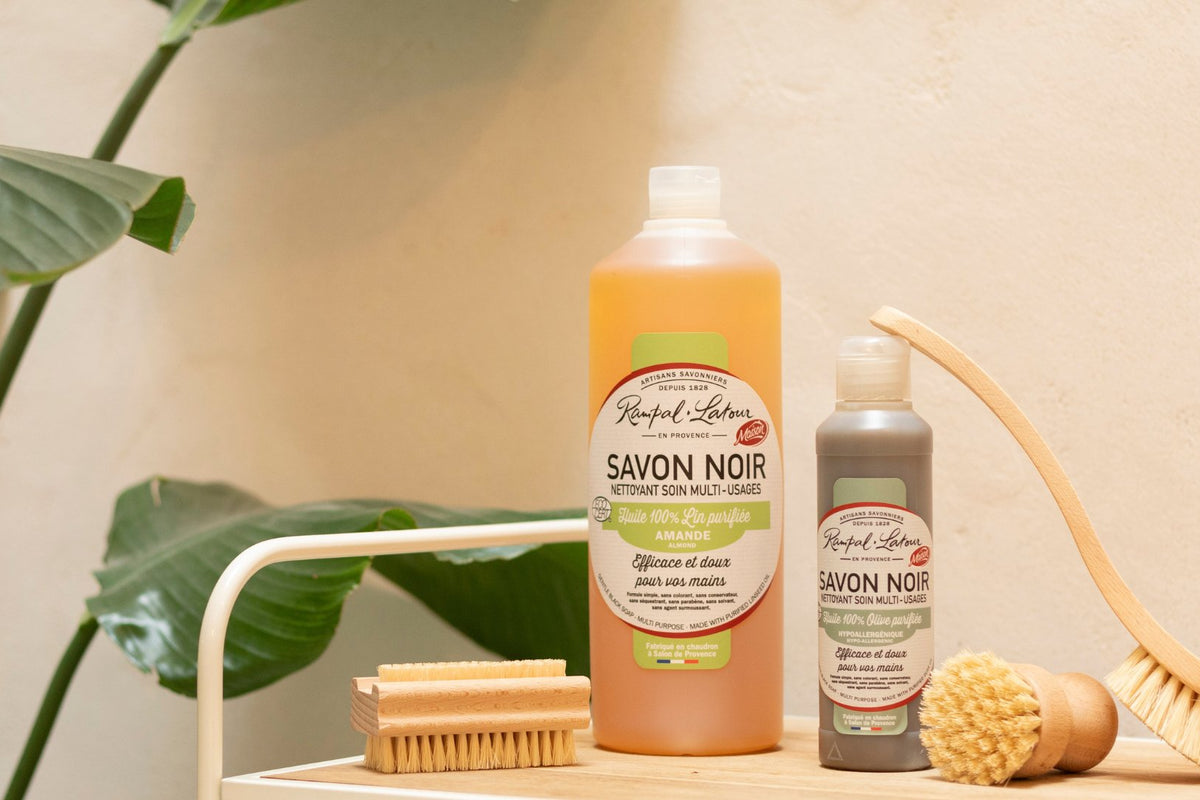


Five values guide Rampal Latour every day: respect for tradition, quality, human relationships, authenticity, and tradition.

Respect
Rampal Latour's foremost mark of respect is for tradition. The regard shown for the age-old art of Provençal soap-making artisans connects the company to its own history, and also opens it up to new ideas and the drive towards new horizons. This respect translates into an attitude of service, within the team and towards customers, and into a form of humility before the perfection of nature, the preferred ingredient in all the company's soaps. Finally, it leads to staying true to what is simple, good, and true, the very signature of the brand.

Quality
At Rampal Latour, quality goes back to its original meaning: a way of being, before being a result. It can be summed up in the aspiration to improve people's lives through every soap that leaves the artisan soap factory. This consistency is both the source and the fruit of the attention paid to internal relations, customers, and suppliers; it is the company's way of achieving what sets it apart: the very meaning of the artisan soap maker's work.

The relationship
Every relationship is an exchange, a bond that unites and allows us to transmit what we consider good. By its very nature, soap fosters these interactions: at the heart of the daily life of a soap factory, it conveys an authentic and universal message, that of the trust born from genuine attention to others. As a team, with clients as well as with suppliers, reciprocity defines the meaning of the relationship at Rampal Latour: to give, to receive, to welcome unreservedly.

Authenticity
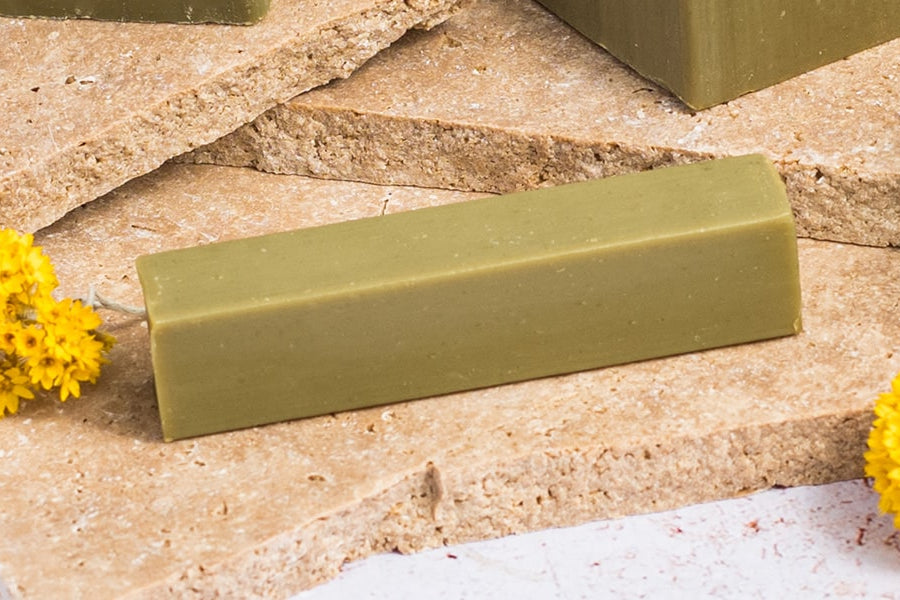
Authenticity is the value to which the entire team is committed and expresses its identity. It is based on a lively consistency in the house's history, in the tradition of its artisanal know-how, and in the constant quality of its soaps. It stands out as an obvious choice through Marseille soap, representative of a unique and therefore unchangeable heritage, with only four ingredients: vegetable oils, water, lye, and salt. This same authenticity is found in the purity of all the natural soaps in the range: being simple, good, and true, every day.

Tradition
Tradition is a legacy, a teaching, a responsibility received and carried every day, which the soap factory loves to share. With soap as the vector of this tradition, Rampal Latour's artisanal know-how remains a strength passed down from hand to hand, a living testament to a tradition of courage, audacity, resilience, innovation, unity, and respect. Sharing the heritage, enriching it, and always innovating: this is how the company defines its authenticity, its way of doing things, and its lifestyle.
Our commitment to fighting deforestation and promoting responsible palm oil
As early as 2011, Rampal Latour took on the issue of palm oil, long before it became a mainstream concern. The issue particularly affects white Marseille soap, whose traditional recipe combines copra oil and palm oil, alongside olive oil for the green version. Rather than simply removing this ingredient, a solution that would have denatured the historic recipe of Marseille soap, the soap factory chose at that time to source palm oil certified sustainable by the RSPO (Roundtable on Sustainable Palm Oil), the reference at the time for traceability.
Aware of current criticisms of palm oil, Rampal Latour has since considered a more comprehensive removal of this ingredient, an issue that is not simply resolved, as it touches on the very balance of the traditional recipe. To go further, Rampal Latour Marseille soap is now COSMOS certified: the purified oils used are validated by Ecocert according to a standard that imposes production rules compliant with green chemistry. A figure worth remembering, too often ignored: soap manufacturing represents no more than 1% of global palm oil consumption, compared to 80% for food alone.
Our Organic and Safelife certified ranges


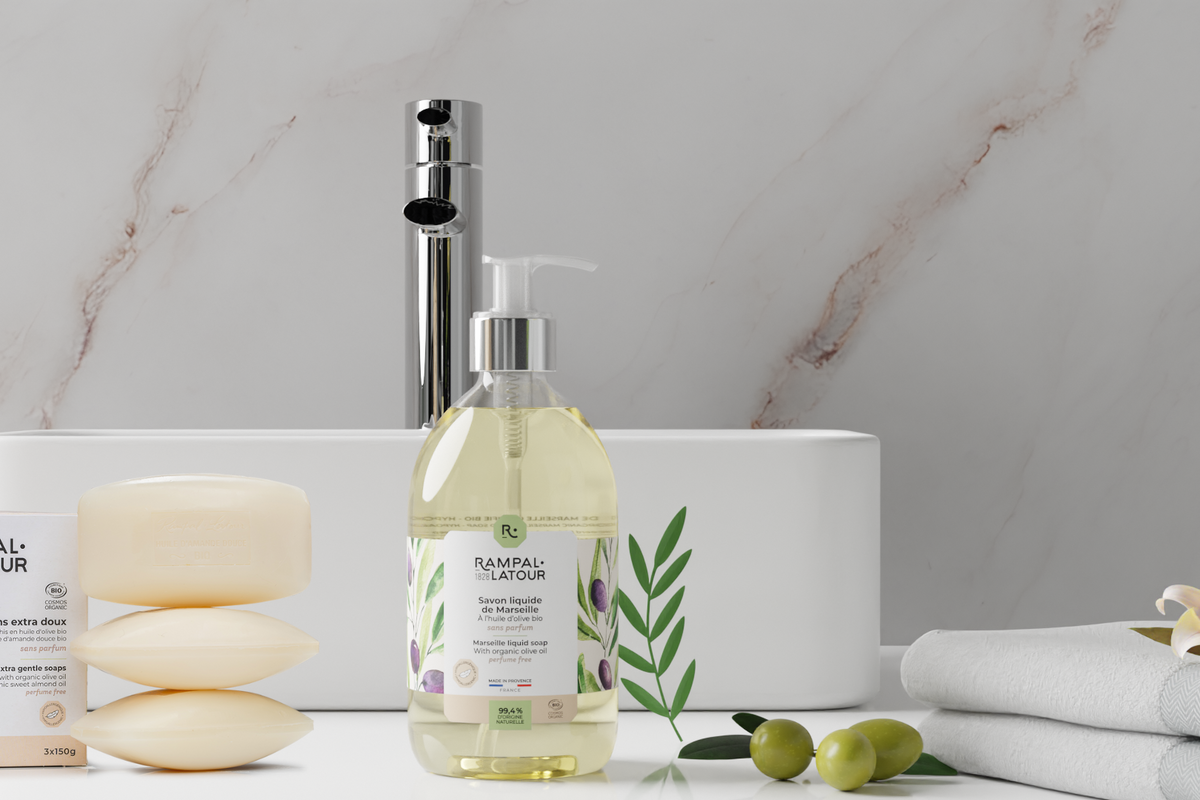
Rampal Latour's organic commitment is nothing new: as early as 2007, the soap factory established its own Nature Charters, which transparently set out its naturalness requirements. This approach led in 2008 to the launch of a first range of certified organic shampoos, shower gels and soaps, approved by Ecocert and labeled Cosmébio, with a level of requirement higher than the sector's standards: 99% guaranteed natural ingredients, when certification only requires 95%. In 2010, this range was distinguished as "Best Organic Range of the Year" at the New York Gift Show, the major international showcase for the cosmetics sector.
Specifically, this requirement is translated ingredient by ingredient: certified organic virgin olive, sweet almond, and argan oils to nourish the skin, organic Aloe Vera and Biolipide active ingredient (derived from coconut and sunflower) to moisturize it, superfine green clay to purify it, 100% natural fragrances composed by French perfumers in Grasse. No PEG, silicone, paraben, glycol, GMO, or artificial coloring is included in the formulas, and the packaging follows the same logic: recyclable bottles, 100% compostable soap bags, certified to EN 13432.
In 2019, this requirement took a further step with the launch of the Safelife range, designed specifically for the most sensitive skin, that of babies and pregnant women. Safelife applies a strict precautionary principle: over 180 potential allergens and endocrine disruptors are excluded from the formulations, based on a list established by toxicologist experts.
The EPV label: Recognition from the French State

For several years, Savonnerie Rampal Latour has been awarded the “Entreprise du Patrimoine Vivant” (EPV) label by the French government, under the aegis of the Ministry of Economy and Finance. This distinction rewards three specific criteria: excellence of know-how, possession of a rare economic heritage, and the cultural influence of an activity and its territorial roots. As such, Rampal Latour joins a national network of excellent companies, united by common values: adaptability, responsiveness, innovation, and passion for the craft.
It is largely thanks to its Marseille soap that the soap factory has obtained this recognition. The so-called "Marseilles" process, of which its master soap makers are the heirs, indeed meets the criteria set as early as 1688 by the Edict of Colbert, one of the oldest industrial specifications in France. To preserve the authenticity of this product and protect consumers, Rampal Latour fully adheres to this tradition, through three precise commitments: an Extra Pure soap, made exclusively from 100% purified vegetable oils, with at least 72% guaranteed at the finish; a Natural soap, without perfume, without dye, without preservative, whose cube is traditionally stamped on its six sides; an Extra Mild soap, the soap factory having gone further than tradition to make its Marseille soap even gentler on the skin.
Our plea for a geographical indication for Savon de Marseille
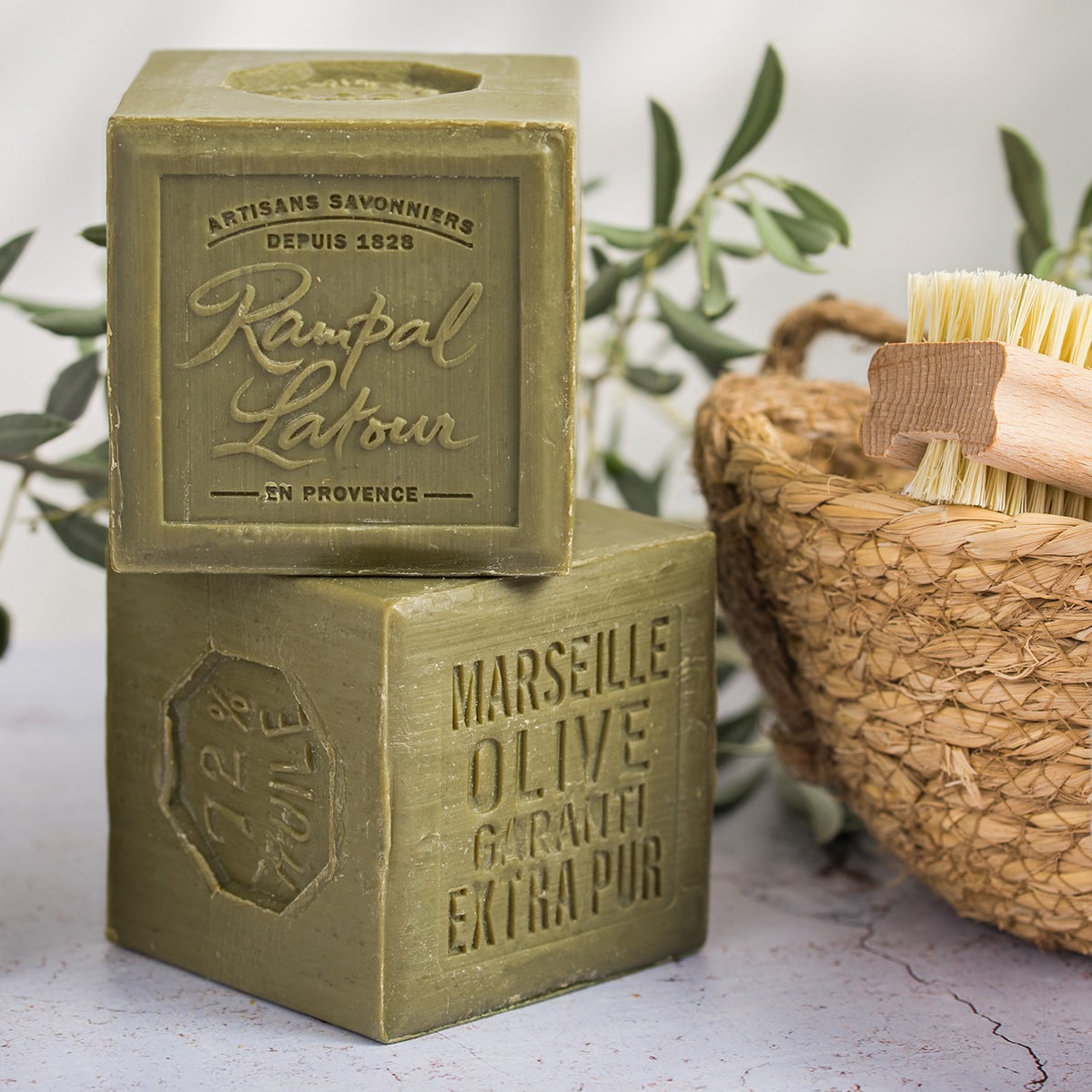
Marseille soap today suffers from a paradox: the stronger its reputation in the world, the more it attracts counterfeits. The reason is simple: the name "Marseille soap" currently has no legal protection. Any soap, regardless of its origin, composition, or manufacturing method, can therefore legally be sold under this name. Rampal Latour actively campaigns for the creation of a geographical indication (GI) that would fill this legal void, protect consumers, and guarantee product quality.
While awaiting such protection, the soap factory has made it its mission to demystify this legendary soap and help everyone distinguish the authentic from the copy. Five simple criteria make it possible to distinguish a real Marseille soap: 100% vegetable oils (identifiable on the label under the mentions Sodium Olivate, Cocoate, or Palmate, never Sodium Lardate or Tallowate, which betray animal fat); a minimum of 72% oil, with the mention "72%" or "Extra Pur" molded on one of the six sides of the cube, alongside the name of the manufacturing soap factory; a recipe of maximum six ingredients, oils, water, soda, and salt, without perfume, preservatives, or synthetic adjuvants; the total absence of coloring, the soap's shade (green to brown for olive oil, white to beige for copra and palm) coming solely from the oils used; and a manufacturing process in a cauldron, the only guarantee of an ancestral savoir-faire respected from start to finish.
A final, more historical landmark: the cradle of Marseille soap is located in the Bouches-du-Rhône, where production dates back to the 12th century thanks to local resources in olive oil and soda. Today, very few authentic manufacturers remain in this historic area; Rampal Latour, which manufactures all its soaps in Salon-de-Provence, is one of them.