
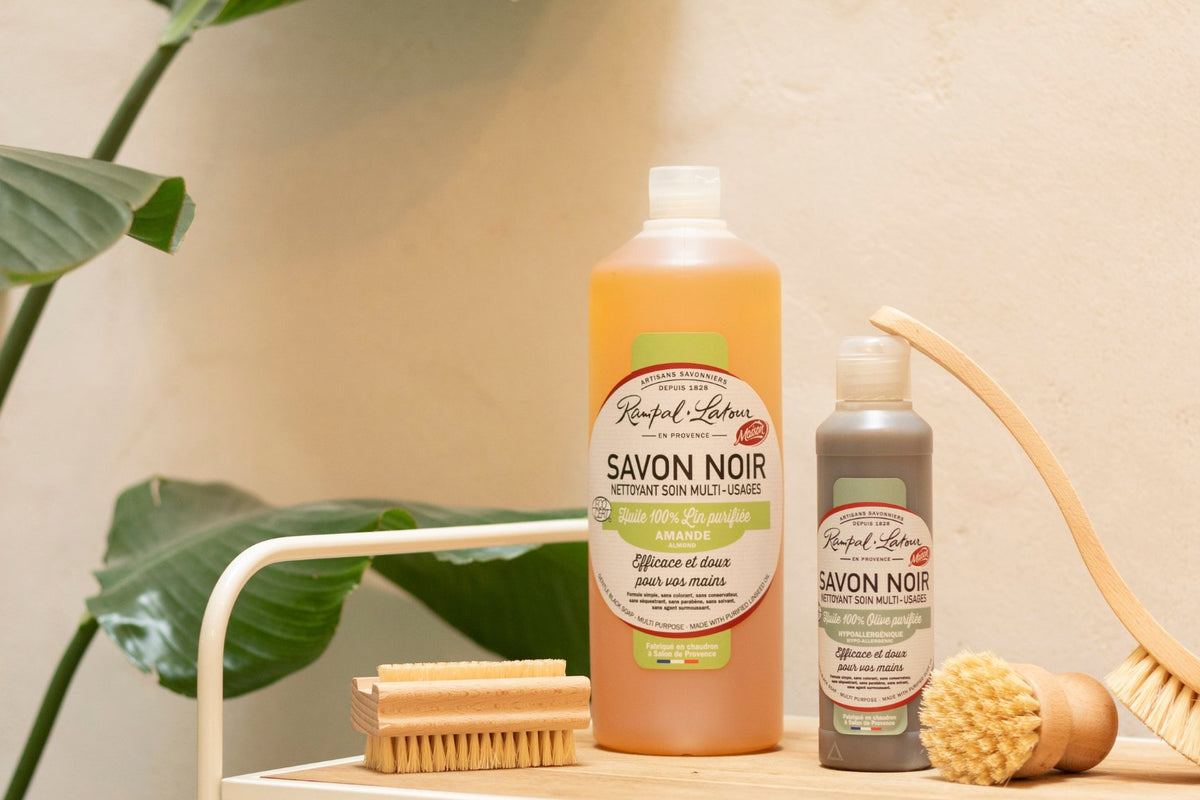


Authentic Marseille soap and the industrial soaps commonly found in stores have fundamental differences that go far beyond their mere appearance. These distinctions affect both their composition, manufacturing methods, and their impact on our skin and the environment.
What is real Marseille soap?
Marseille soap is an exceptional product, the result of ancestral expertise born and preserved in Provence. However, as the name is not protected, it is crucial to know how to spot the authentic one. To recognize a real Marseille soap, rely on these unchanging characteristics:
- A strict composition (the 4-ingredient rule): It must exclusively contain vegetable oils (minimum 72%), water, salt, and lye. No superfluous additives are allowed.
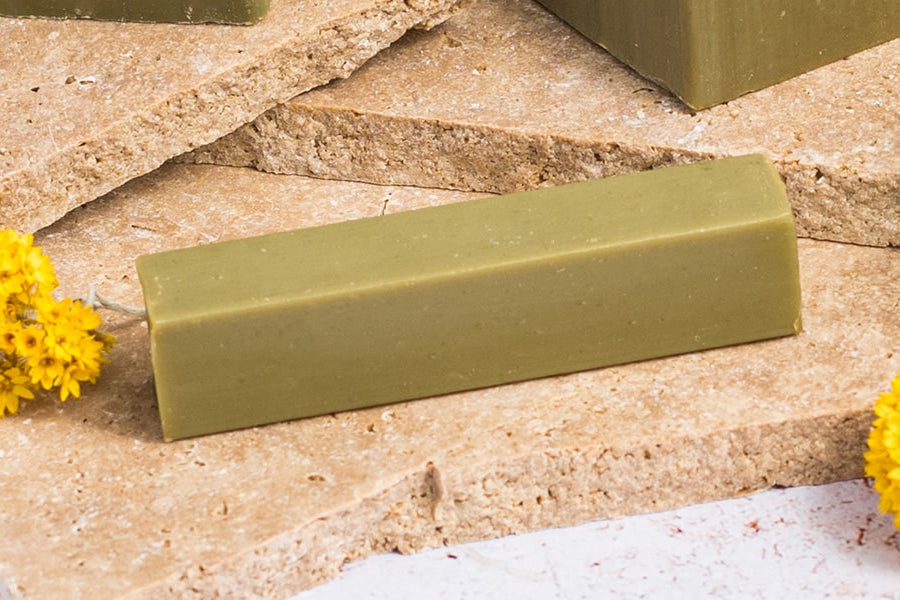
- A pure appearance: Without added colorant or fragrance, its color simply reflects the oils that compose it. It is either green (olive oil-based), or white (vegetable oil-based).
- Traditional manufacturing: It is made using cauldron cooking according to the centuries-old Marseille process.
Although the traditional process removes glycerin during the paste washing, Rampal Latour has developed a major innovation. Thanks to a patented process that preserves the glycerin naturally formed during saponification, the soap factory offers a real Marseille soap that does not dry out the skin, combining tradition and hydration.
Naturally effective, this soap is a versatile everyday ally. The green soap is generally preferred for home and laundry care, while the white soap will be ideal for body washing and hand cleaning.
How is industrial soap made?
In general, industrial soaps are designed for fast and economical mass production. Their manufacturing mainly uses cold saponification or synthetic cleansing bases, allowing production in just a few hours.
In the composition of industrial soaps, there are generally chemical preservatives, artificial colorants, and synthetic fragrances. Although these additives allow for attractive textures and intense fragrances, they can also be sources of irritation for sensitive skin.
What are the benefits of Marseille soap for the skin?
Rampal Latour Marseille soap is known for its gentleness and exceptional tolerance, even on the most delicate skin. It is free of colorants, preservatives, and also synthetic fragrances, making it hypoallergenic. Thanks to its richness in natural vegetable glycerin from the cauldron saponification process, it helps preserve skin hydration.
In summary, Marseille soap is a simple, healthy, and multifunctional product that respects the skin barrier while cleaning the skin effectively. It is suitable for the whole family, babies and young children, as well as pregnant women. People with reactive skin or prone to eczema will appreciate its gentleness.
And what about industrial soaps?
Even though some industrial soaps are pleasant to use in the short term thanks to their intense fragrance and abundant foam that gives a "silky" effect, their composition often poses problems in the long term. Indeed, the presence of controversial products such as sulfates, silicones, and synthetic colorants can alter the skin's natural hydrolipidic film, making it drier or irritated.
It is important to know that during the traditional manufacturing of any real Marseille soap, the naturally formed glycerin is systematically removed during the paste washing stage. This is where the great Rampal Latour difference lies: the soap factory made the exclusive choice to innovate to preserve this precious glycerin at the heart of its soap. Unlike other classic Marseille soaps, it is therefore not deprived of this highly moisturizing agent.
Environmental impact: a decisive criterion
Beyond cosmetic considerations, the environmental impact is a major issue if you have to choose between a Marseille soap and an industrial soap. Traditional Marseille soap fits into a zero-waste approach. Its natural composition and manufacturing method are assets for the environment and allow it to be a sustainable product.
Conversely, industrial soaps often generate a larger carbon footprint. Their production requires complex and energy-intensive chemical processes. The synthetic surfactants, preservatives, and artificial fragrances that compose them can persist in the environment, which disrupts terrestrial and aquatic ecosystems. Not to mention the microplastics that are present in some formulas and which also contribute to marine pollution!
Finally, let's talk about packaging. And yes, it is also part of the differences between Marseille and industrial soap! Marseille soaps are traditionally sold without plastic packaging or in minimalist recyclable paper packaging. As for industrial soaps, they are generally packaged in plastic bottles or complex packaging, mixing different materials, which we know today are difficult to recycle.
Sustainability and economy: the long-term calculation
To finish this list of differences between a Marseille and industrial soap, let's mention the economic aspect of these two products. Although the purchase price of a Marseille soap may seem higher than that of an industrial soap, the calculation over the duration of use often reveals an advantage for the traditional product. A 300-gram cube of Marseille soap can last several months of daily use, whereas a bottle of industrial liquid soap runs out in a few weeks.
This longevity is explained by the concentration of active ingredients. Its clean formulation makes it a particularly economical product. In addition, Marseille soap has multiple uses. By choosing Marseille soap shavings, you get an effective laundry detergent. Solid Marseille soap can, on the other hand, be used in the form of a stain remover for laundry, for example. It is a multi-use product that will take care of your skin and help you in the maintenance of your home!
Recognition and certification: how to find your way?
The absence of a controlled designation of origin for Marseille soap sometimes complicates the consumer's choice. However, certain labels and certifications allow to identify authentic products. The Cosmos Natural certification, for example, guarantees the natural origin of the ingredients and the absence of controversial substances.
Rampal Latour, master soap maker since 1828, makes it a point of honor to respect the traditional methods of Marseille soap. For greater transparency, we clearly indicate our traditional manufacturing method as well as our ingredients. The consumer can thus verify the authenticity of our Marseille soap when purchasing it!
The art of choosing: essential criteria
To choose well between Marseille soap and industrial soap, several criteria must guide your decision. First, examine the list of ingredients. Remember that a real Marseille soap should only contain a few components: saponified vegetable oils (minimum 72%), water, salt, and lye. Beware of ingredient lists that are too long or contain names that are difficult to pronounce.
Geographical origin is also a reliable indicator. Provençal soap factories perpetuate an ancestral know-how which is generally proof of quality. Do not hesitate to inquire about the history and production methods of the brand you are considering buying!
Finally, consider your specific needs. If you are looking for a versatile product for the whole family, respectful of the environment and economical in the long term, authentic Marseille soap represents a wise choice. Its apparent simplicity actually hides a formidable effectiveness, the result of centuries of optimization and refinement of the traditional recipe.